
Expert Shoulder Injury Treatment Beaumont TX
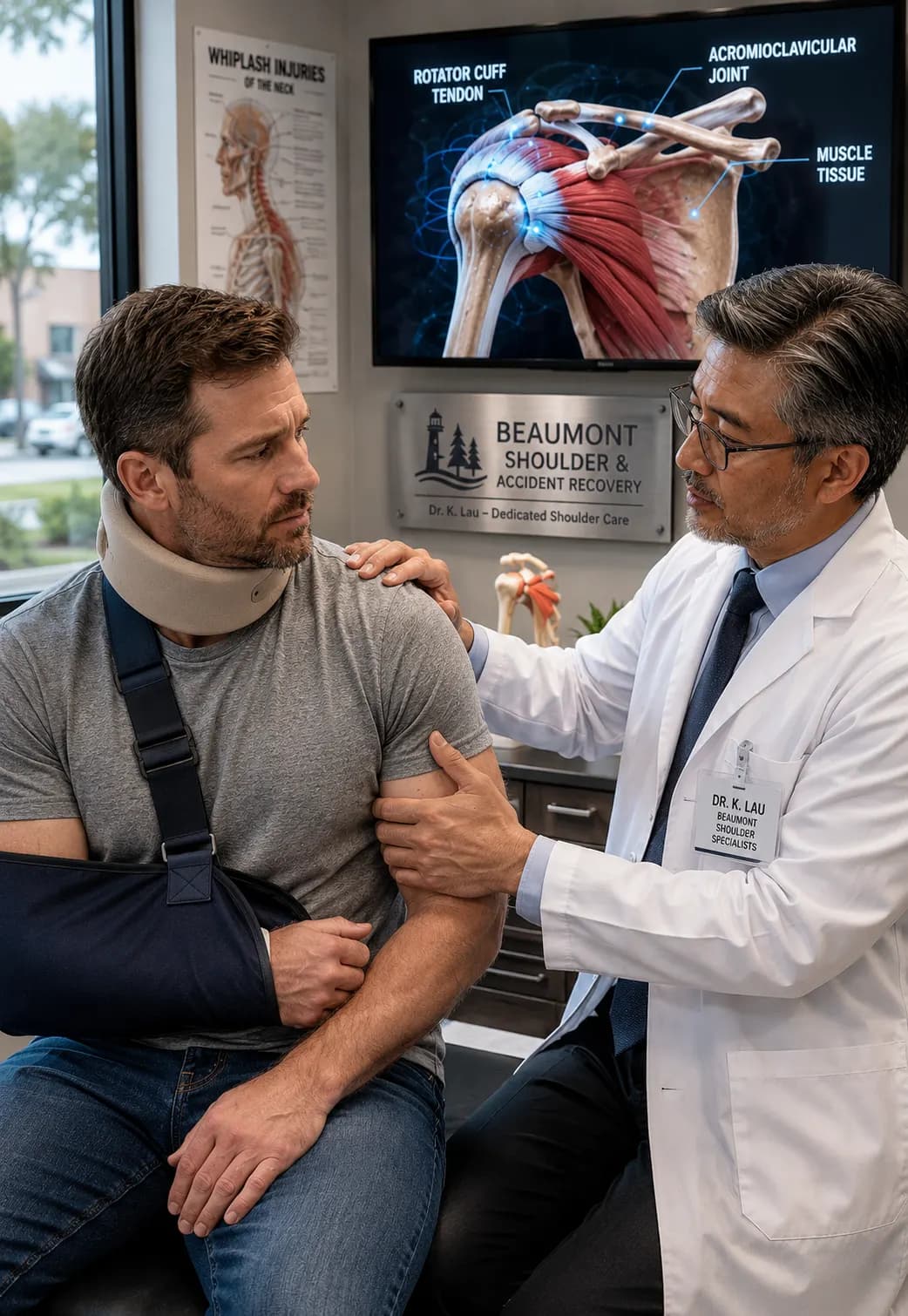
Shoulder injuries are among the most common findings after a motor-vehicle accident — often from the seat belt running diagonally across the chest and shoulder during the crash. The result can range from a bruised acromioclavicular (AC) joint to a rotator cuff strain or tear, a labral injury, or a fracture of the clavicle or proximal humerus. Most shoulder injuries respond to conservative care; surgery is reserved for clear structural tears, displaced fractures, and persistent symptoms that fail conservative treatment.
Medically reviewed by Deepak Sharma, DC · Last reviewed · Updated
Quick answer · Key facts
- The seat belt crosses diagonally over the shoulder — protective overall, but a common cause of bruising, AC-joint sprain, and rotator cuff strain.
- Common MVA shoulder injuries: rotator cuff strain or tear, AC-joint sprain or separation, labral tear (including SLAP), clavicle or proximal humerus fracture, and dislocation.
- X-ray is the first-line imaging for suspected fracture, dislocation, or significant AC-joint injury; MRI is preferred for soft tissue (rotator cuff, labrum).
- Most rotator cuff strains, partial tears, and AC sprains improve with conservative care over several weeks.
- Orthopedic referral is appropriate for full-thickness tears, dislocations, displaced fractures, and persistent loss of motion or function.
- Medically reviewed by Deepak Sharma, DC.
How does a car accident injure the shoulder?
The shoulder is the most mobile joint in the body and depends on a complex of soft tissues — the rotator cuff, the labrum, and the AC and glenohumeral ligaments — for stability. In a crash, two mechanisms drive most injuries:
First, the seat belt crosses the chest diagonally and restrains the upper body. The shoulder takes a concentrated, high-velocity load along that band. Second, instinctive bracing against the steering wheel or door drives force up the arm into the shoulder. Either mechanism can strain or tear the rotator cuff, sprain or separate the AC joint, injure the labrum, or fracture the clavicle or proximal humerus.
The NIH MedlinePlus resources are a useful reference for patients seeking patient-facing detail on these injuries.
The seat belt saves your life and bruises your shoulder. Both can be true — and the bruising still deserves a real evaluation.
What kinds of shoulder injuries do we treat?
Rotator cuff strain or tear
Pain with lifting the arm, weakness, and night pain are typical. Tears may be partial or full-thickness.
AC-joint sprain or separation
Tenderness and sometimes a visible bump at the top of the shoulder, worse with reaching across the body.
Labral tear (including SLAP)
Deep shoulder pain, catching or clicking, and instability — common with the labrum where the biceps tendon attaches.
Clavicle fracture
Pain, swelling, and sometimes a deformity over the collarbone — frequent with seat-belt loading.
Proximal humerus fracture
Pain at the top of the upper arm with limited motion — more common in older patients or higher-energy crashes.
Glenohumeral dislocation
The ball of the shoulder comes out of the socket — visibly deformed and very painful; needs urgent reduction.
Shoulder contusion
Bruising of the muscles and soft tissues from direct or seat-belt impact.
Adhesive capsulitis ("frozen shoulder")
Stiffness that develops weeks after a crash, especially if early motion was limited — preventable with timely PT.
When is a shoulder injury an emergency?
Most shoulder injuries do not require an emergency room, but a few do. Call 911 or go to the nearest emergency department for any of the following:
- An obviously deformed or dislocated shoulder
- An open wound over the shoulder, or a bone visible through the skin
- Numbness, tingling, or weakness down the entire arm or hand
- Loss of pulse, a cold hand, or skin that is pale or blue below the injury
- Severe pain with chest pain, shortness of breath, or difficulty breathing
- An inability to move the arm at all, especially with significant swelling
Short of these red flags, ongoing shoulder pain, weakness, or stiffness after a crash deserves prompt evaluation — early diagnosis tends to make conservative treatment more effective and helps prevent secondary problems like frozen shoulder.
How do we diagnose shoulder injuries after a crash?
Diagnosis is a careful clinical decision, supported by selective imaging. We do not order imaging by default — the exam tells us what is needed.
- 1
History and mechanism review
Crash direction, seat-belt position, bracing, and timeline of pain help map the likely injury before we touch the shoulder. - 2
Clinical exam
Inspection for swelling, deformity, or bruising; palpation of the AC joint, clavicle, and humerus; range-of-motion testing; and special provocative tests for the rotator cuff, labrum, and instability. - 3
X-ray when indicated
Plain films assess for fracture, dislocation, or significant AC-joint separation — useful first if bony injury is suspected. - 4
MRI for soft tissue
MRI (sometimes with intra-articular contrast) is the imaging of choice for rotator cuff and labral tears. - 5
Conservative trial and reassessment
Without red flags, most patients begin conservative care with close follow-up to track progress. - 6
Orthopedic referral when needed
Suspected full-thickness rotator cuff tear, labral tear with mechanical symptoms, displaced fracture, or recurrent dislocation prompts specialist consultation.
What does treatment look like? Conservative-first, with surgery when needed
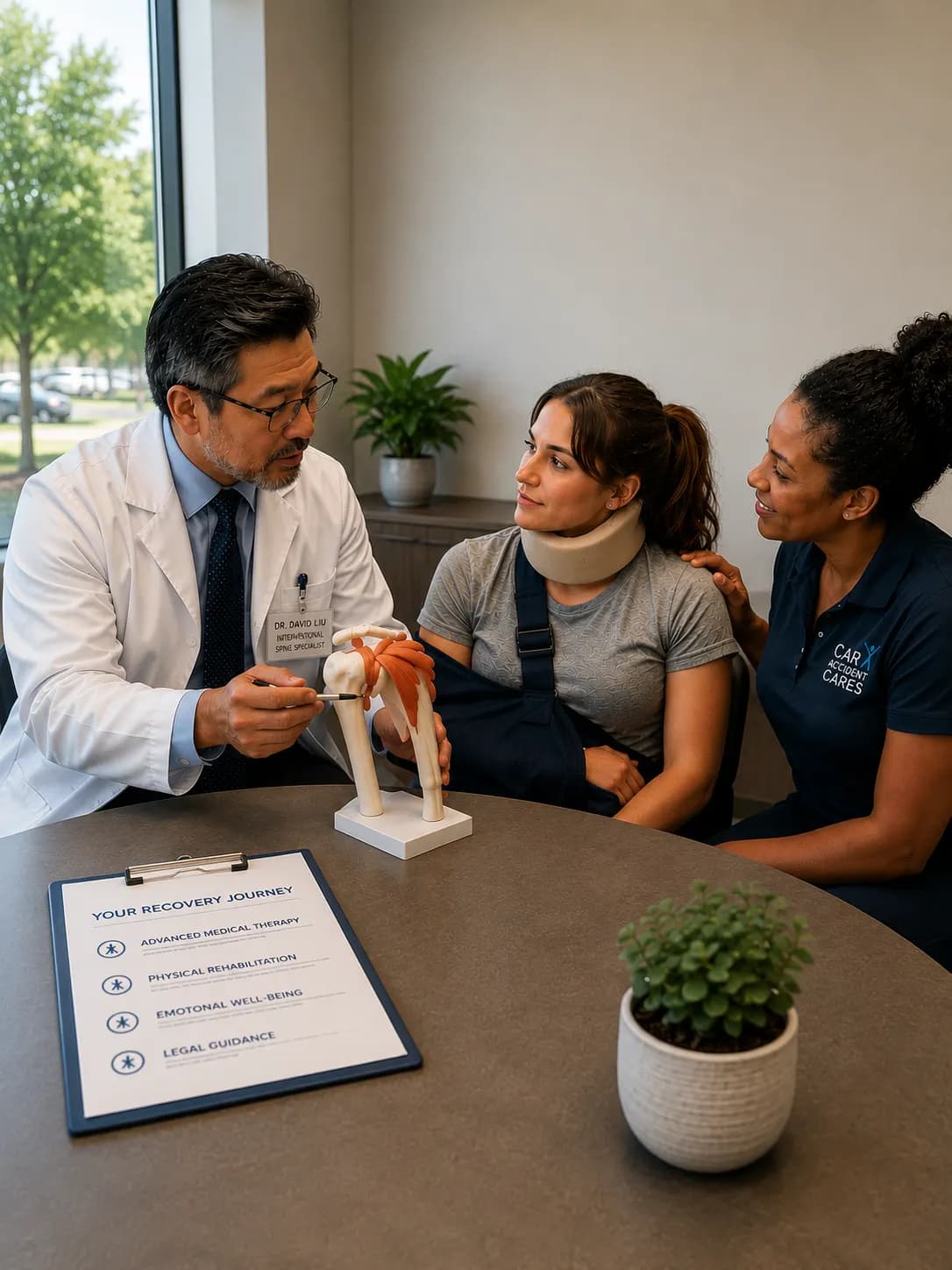
For most rotator cuff strains, AC-joint sprains, partial cuff tears, and contusions, recovery starts with conservative care: short-term anti-inflammatories or analgesics as appropriate, brief activity modification (a sling for the first few days when indicated, then progressive motion to avoid stiffness), and a guided physical therapy program targeting scapular control, cuff strength, and gradual range of motion.
Selected patients benefit from a subacromial corticosteroid injection when impingement and bursitis dominate the picture. Surgical referral — typically arthroscopic — is appropriate for full-thickness rotator cuff tears in active patients, displaced clavicle or humerus fractures, persistent labral injury with mechanical symptoms, recurrent dislocation, or symptoms that fail an adequate conservative trial. Early motion, even when motion is limited, helps prevent frozen shoulder — a common avoidable complication.
Shoulder care: cost, insurance & attorney liens in Beaumont
The cost of evaluating and treating a shoulder injury depends on imaging and the specific care plan, and your coverage depends on your specific plan. We coordinate directly with health insurers and personal-injury attorneys so paperwork does not slow your recovery.
If you do not have health insurance or are waiting on a settlement, ask about our lien-friendly arrangements: you can be evaluated, imaged, and treated now, with payment deferred and resolved through your accident claim.
Why early shoulder care matters
Two clocks start the moment of a crash — one medical, one legal. Medically, the shoulder is unforgiving when it is immobilized too long: a few extra weeks of stiffness can become a frozen shoulder that takes many months to resolve. Early evaluation lets us start the right balance of rest and motion.
For your claim, a documented gap between the accident and your first visit can be used by an insurer to question whether the crash caused your injury at all. An early dated record protects both your recovery and your case.
Why choose Car Accident Cares for shoulder treatment
From the first exam to imaging and rehabilitation, we build shoulder care around accident recovery — clinical, coordinated, and documented.
Physician-led, conservative-first care
Selective, accurate imaging
Same-week evaluation
PT designed to prevent frozen shoulder
Clear orthopedic referral pathway
Lien-friendly billing
A shoulder that moves a little, early, almost always finishes better than a shoulder that rests for too long.
Services we use to treat this injury
Chiropractor Care in Beaumont
Spinal alignment, soft-tissue manipulation, and adjustment therapies to relieve back and neck pain after a collision.
Learn moreMD Consultation in Beaumont
Initial medical evaluation by a licensed primary-care MD to document injuries and coordinate downstream care.
Learn moreBest Affordable Beaumont MRI Diagnostic Imaging Service
High-field MRI for soft-tissue, disc, and ligament injuries — same-week appointments and transparent pricing.
Learn morePain Management Consultants in Beaumont
Non-surgical interventional pain specialists — trigger-point, epidural, facet joint, and medication management.
Learn moreOther injuries patients often have together
Whiplash & Neck Pain Treatment
The #1 injury seen after rear-end collisions — even at low speeds.
See protocolHerniated Disc Doctor
Sciatica, radiating pain, and weakness from disc injuries.
See protocolLower Back & Knee Pain Treatment
Lumbar strain, ligament damage, and post-collision joint pain.
See protocolChest Pain
Costochondritis, sternum injury, and seatbelt syndrome evaluation.
See protocolFrequently Asked Questions About Shoulder Injuries
Don't see your question? Call us at (409) 834-4100 — we answer 24/7.
How does a seat belt cause a shoulder injury?
The seat belt runs diagonally across the chest and shoulder. In a crash it restrains the upper body — saving lives — but it also delivers a concentrated load to the shoulder. This can bruise the soft tissues, sprain the AC joint, strain the rotator cuff, or, in higher-energy collisions, contribute to a clavicle fracture.What is a rotator cuff injury and how do I know if I have one?
The rotator cuff is a group of four tendons that surround and stabilize the shoulder. A strain or tear typically causes pain with lifting the arm, weakness when reaching or lifting, and night pain when lying on that side. A clinical exam and, when needed, an MRI confirm the diagnosis.What is the difference between an AC-joint sprain and a shoulder dislocation?
An AC-joint sprain affects the small joint at the top of the shoulder where the collarbone meets the shoulder blade; it often produces a tender bump. A glenohumeral dislocation is the ball of the shoulder coming out of its socket — visibly deformed and very painful, and it needs urgent reduction in the emergency department.Do I need an MRI for my shoulder injury?
Not always. For most patients without red flags, we start with a clinical exam and selective X-ray when fracture or dislocation is suspected. MRI is the imaging study of choice for the rotator cuff and labrum and is ordered when those structures are clinically in question or when symptoms do not improve.Do most shoulder injuries from a car accident need surgery?
No. The majority of rotator cuff strains, AC-joint sprains, partial tears, and contusions improve with conservative care — anti-inflammatories, brief rest, and structured physical therapy. Surgery is reserved for full-thickness tears, displaced fractures, labral tears with mechanical symptoms, recurrent dislocation, or symptoms that fail an adequate conservative trial.How long does shoulder recovery take?
Recovery varies. Minor strains and sprains often improve over a few weeks; partial cuff tears and AC injuries may take six to twelve weeks of PT; full-thickness tears and post-surgical rehabilitation can take several months. Frozen shoulder, when it develops, can extend recovery substantially — which is why early motion matters.What is frozen shoulder and can it be prevented?
Frozen shoulder (adhesive capsulitis) is progressive stiffness and pain that develops when the shoulder is not moved enough during recovery. It is a common complication after immobilization. Early, guided motion — built into the PT plan from the first visit — significantly reduces the risk.I think my shoulder is dislocated — what should I do?
Do not try to move it back yourself. Go to the nearest emergency department or call 911. Dislocations need controlled reduction, sometimes with sedation, and an evaluation for associated fracture or nerve injury.Will my insurance or an attorney lien cover shoulder treatment?
Coverage depends on your specific plan and the care recommended. We coordinate with health insurers and personal-injury attorneys, and we offer lien-friendly arrangements so you can be evaluated and treated now and resolve payment through your settlement.Why should I be seen soon after the crash even if my shoulder feels okay?
Shoulder swelling and stiffness often peak days after the impact. Early evaluation lets us catch a problem before it entrenches, start the right balance of rest and motion, and create a dated record that links your injury to the accident.
Deepak Sharma, DC is a licensed Doctor of Chiropractic and the owner of Car Accident Cares in Beaumont, TX. He reviews the clinical content published across the site and works with a multidisciplinary network of MDs, chiropractors, imaging centers, and pain-management specialists focused on accurate diagnosis, evidence-based treatment, and complete recovery for motor-vehicle-accident victims across Beaumont and Houston.
Explore Blog

What to Expect from Your Whiplash Recovery Timeline Texas After a Car Accident
Most whiplash patients recover within 6 to 12 weeks with appropriate care — but that window is not guaranteed, and for Beaumont drivers dealing with delayed sy…

Can a Car Accident Aggravate a Pre-Existing Condition in Texas?
If you have been involved in a motor vehicle collision in Southeast Texas, you likely have countless questions running through your mind. Assessing vehicle dam…
Understanding Different Types of Car Accident Impacts and Injuries
Driving through busy Beaumont TX—especially near intersections on Dowlen Road, along Interstate 10, or through the heavy traffic on College Street—means dealin…
Find Auto Injury Specialist Near You
Same-week appointments. Lien-friendly billing. Over 100 clinic locations across Beaumont and Houston.