
Compassionate PTSD Treatment After Car Accidents in Beaumont TX
Post-traumatic stress disorder (PTSD) after a motor-vehicle accident is meaningful, treatable, and often under-recognized. It can develop when the mind has trouble processing the shock of a collision — producing intrusive memories, avoidance, hyperarousal, and changes in mood or thinking that last beyond the first weeks. According to the U.S. Department of Veterans Affairs' National Center for PTSD, motor-vehicle accidents are among the most common traumatic events that lead to PTSD in civilians. Evidence-based therapies work, and reaching out early helps. If you or someone you love is in crisis, call or text 988 — the Suicide & Crisis Lifeline — anytime, day or night.
Medically reviewed by Deepak Sharma, DC · Last reviewed · Updated
Quick answer · Key facts
- PTSD can follow a serious car accident and is officially diagnosed when symptoms persist for more than one month and cause significant distress or impairment.
- Core symptoms cluster into four groups: intrusion (flashbacks, nightmares), avoidance, negative changes in mood or thinking, and hyperarousal (jumpiness, sleep problems).
- Symptoms in the first weeks are common and may meet criteria for acute stress disorder rather than PTSD — many people recover on their own.
- Effective treatments include trauma-focused psychotherapy (CBT, EMDR, prolonged exposure) and, in selected cases, SSRIs prescribed by a psychiatrist.
- PTSD and physical injury often interact — chronic pain, sleep loss, and avoidance behaviors can each make the other harder to treat.
- If you are in crisis, call or text 988 (Suicide & Crisis Lifeline). For a life-threatening emergency, call 911.
- Medically reviewed by Deepak Sharma, DC.
What is PTSD after a car accident?
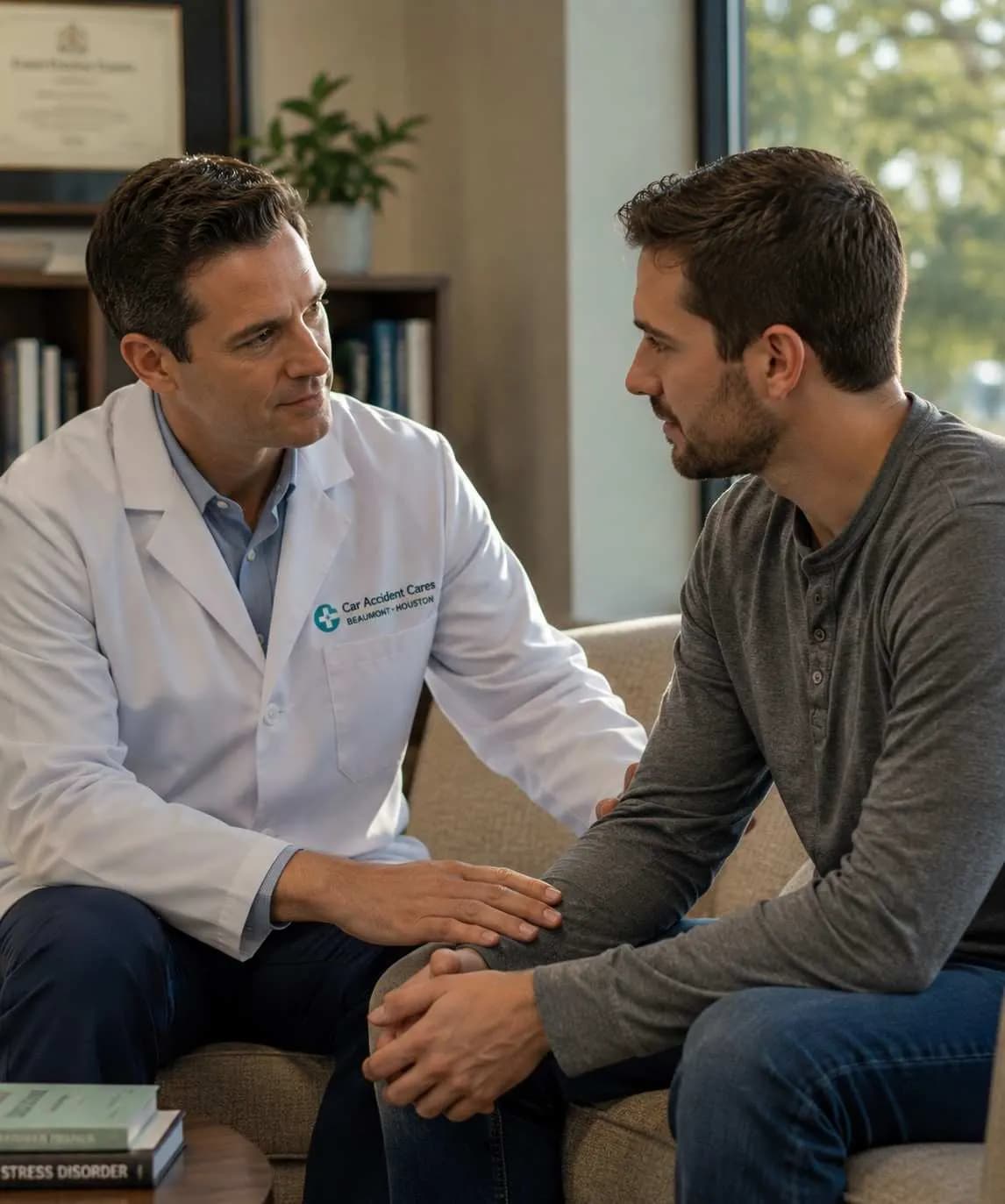
PTSD is a recognized medical condition that can develop after exposure to an event involving actual or threatened death, serious injury, or violence — and a serious car crash qualifies. According to the National Center for PTSD, motor-vehicle accidents are one of the most common traumas leading to PTSD among civilians.
It is important to know that acute stress symptoms in the first month are common and often resolve on their own. PTSD is formally diagnosed when symptoms last longer than one month and cause meaningful distress or interfere with daily life. The National Institute of Mental Health (NIMH) and the American Psychiatric Association describe the same framework.
You are not weak for experiencing PTSD after a crash, and you are not alone. Asking for help is a clinical step, not a personal failure.
After a serious crash, the body bruises and heals — and so does the mind. Sometimes the mind just needs a little more help finding the way back.
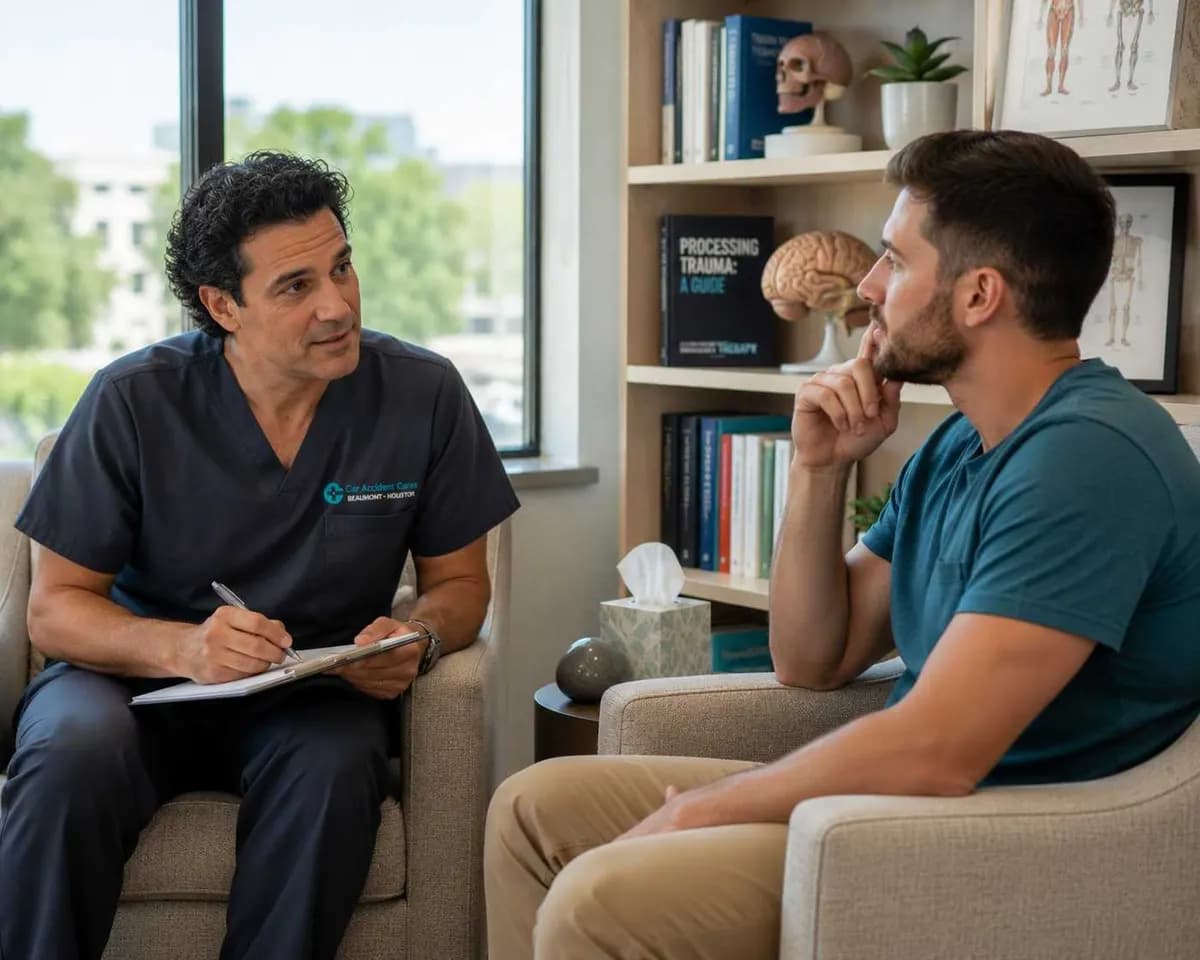
What are the symptoms of PTSD?
Intrusive memories
Unwanted images of the crash, flashbacks, nightmares, or strong emotional reactions to reminders.
Avoidance
Avoiding driving, certain roads or intersections, conversations about the accident, or even the car itself.
Negative changes in mood or thinking
Persistent guilt or self-blame, feeling detached, loss of interest in things that used to matter, or trouble feeling positive emotions.
Hyperarousal
Being on edge, easily startled, irritable, struggling to concentrate, or having trouble falling or staying asleep.
Driving-specific fear
Panic at intersections, on highways, or when riding as a passenger — common after MVA-related PTSD.
Physical symptoms
Tension headaches, muscle tightness, chest tightness, and a heart that races when reminded of the crash.
When should you seek help — and when is it an emergency?
If you are experiencing thoughts of suicide, self-harm, or you feel unsafe, please get help right now. You deserve support, and it is available 24/7.
Call or text 988 — the Suicide & Crisis Lifeline. For a life-threatening emergency, call 911 or go to the nearest emergency department.
Outside of crisis, contact a clinician promptly if you notice any of the following lasting more than a few weeks:
- Thoughts of suicide, self-harm, or hopelessness — call or text 988 immediately
- Symptoms that are interfering with work, school, relationships, or sleep
- Avoidance that is shrinking your life — for example, no longer driving at all
- Flashbacks, panic, or nightmares that are not improving over a few weeks
- Using alcohol, cannabis, or other substances to cope with crash-related distress
- Increasing irritability, anger, or feeling emotionally numb or disconnected
Reaching out is a clinical step, not a sign that something is wrong with you. Most people who seek help for PTSD see meaningful improvement with treatment.
How is PTSD treated? Evidence-based options
Major clinical bodies — including the American Psychological Association, the NIMH, and the National Center for PTSD — point to a small number of treatments with the strongest evidence:
Trauma-focused psychotherapies are first-line. These include Cognitive Processing Therapy (CPT) and Prolonged Exposure (PE) — both forms of trauma-focused cognitive behavioral therapy — and Eye Movement Desensitization and Reprocessing (EMDR). Each has been studied extensively and helps many people meaningfully reduce or resolve PTSD symptoms.
Medications can also help. SSRIs such as sertraline and paroxetine are commonly used, and other medications may be considered for specific symptoms like nightmares or sleep disruption. Medication is a decision made with a psychiatrist or primary-care physician, based on your full picture.
Many patients do best with a combination — therapy to process the trauma, plus medication when symptoms are severe — alongside attention to sleep, gentle exercise, and the social supports that help anyone feel grounded again.
What does early support look like?
There is no single right pathway — and early support is often the simplest, most practical step. Here is what a typical course looks like for accident-related PTSD.
- 1
An honest first conversation
Meeting with a clinician to describe what happened, how you've been sleeping, how driving feels, and what is hardest right now. - 2
A careful evaluation
Using validated tools, your clinician determines whether what you're experiencing is acute stress, PTSD, depression, or something else — each has different treatments. - 3
A plan you understand
Treatment is a partnership. You'll review options — therapy type, medication if appropriate, sleep support — and choose what fits your life. - 4
Therapy with measured progress
Trauma-focused therapy (CPT, PE, or EMDR) typically runs over weeks to months, with check-ins on symptom scores so you can see real change. - 5
Coordinated medical care
If pain, sleep, or medication management is part of the picture, your mental-health and medical clinicians coordinate so the plan moves together. - 6
Ongoing support and follow-up
Recovery is rarely a straight line. Follow-up keeps the plan responsive to what's working and what isn't.
Mental health care after an accident: coverage and billing
Many health plans cover behavioral-health visits for accident-related conditions, and your specific coverage depends on your plan. Mental-health treatment can also be coordinated with auto medical-payments coverage and with the personal-injury process when an attorney is involved.
Our team will help you understand what is covered, where to start, and what your out-of-pocket costs would be before any visit. If you are uncertain about cost, please ask — we would rather have that conversation first than have it stand in the way of getting support.
Why early support helps
For PTSD, time alone is not always a good treatment. Some people recover naturally over the first month — and many do — but avoidance can quietly shrink your world (you stop driving on the highway, you stop driving at night, you stop driving at all), and chronic pain and sleep loss can lock symptoms in.
Reaching out early — even before you're sure it's "bad enough" — keeps options open and tends to make treatment shorter and more effective. There is no minimum severity for asking.
Why choose Car Accident Cares for PTSD support
Mental-health care after a crash deserves the same care, coordination, and respect as a physical injury. Here is what we bring to that work.
Evidence-based care
Coordinated with your physical recovery
Compassionate, non-judgmental clinicians
Driving-specific support when needed
Crisis pathway, 24/7
Documentation when you need it
Reaching out is a clinical step, not a sign of weakness. People who ask for help recover — that's not a slogan, it's what the evidence keeps showing.
Hear From Our Satisfied Clients
“I'd freeze at every green light. Therapy here — they used EMDR — gave me my driving life back. I don't have to plan my route around how scared I am anymore.”

“I didn't think what I had counted as PTSD. They listened, ran me through a real evaluation, and we built a plan that actually fit my life. The nightmares are mostly gone.”

Services we use to treat this injury
Chiropractor Care in Beaumont
Spinal alignment, soft-tissue manipulation, and adjustment therapies to relieve back and neck pain after a collision.
Learn moreMD Consultation in Beaumont
Initial medical evaluation by a licensed primary-care MD to document injuries and coordinate downstream care.
Learn moreBest Affordable Beaumont MRI Diagnostic Imaging Service
High-field MRI for soft-tissue, disc, and ligament injuries — same-week appointments and transparent pricing.
Learn morePain Management Consultants in Beaumont
Non-surgical interventional pain specialists — trigger-point, epidural, facet joint, and medication management.
Learn moreOther injuries patients often have together
Whiplash & Neck Pain Treatment
The #1 injury seen after rear-end collisions — even at low speeds.
See protocolHerniated Disc Doctor
Sciatica, radiating pain, and weakness from disc injuries.
See protocolLower Back & Knee Pain Treatment
Lumbar strain, ligament damage, and post-collision joint pain.
See protocolShoulder Injuries
Rotator cuff, labral tears, and seatbelt-related shoulder trauma.
See protocolFrequently Asked Questions About PTSD
Don't see your question? Call us at (409) 834-4100 — we answer 24/7.
Can a car accident really cause PTSD?
Yes. The U.S. Department of Veterans Affairs' National Center for PTSD identifies motor-vehicle accidents as one of the most common traumas leading to PTSD in civilians. A crash that involved actual or threatened serious injury can absolutely cause it, and the diagnosis does not require any specific severity of physical injury.What is the difference between normal post-crash stress and PTSD?
Symptoms in the first few weeks — trouble sleeping, replaying the crash, avoiding the road, jumpiness — are common and often improve on their own. PTSD is diagnosed when these symptoms last longer than one month and cause significant distress or impairment. If you are unsure where you fall, a clinician can help sort it out.What are the main symptoms of PTSD?
Per the American Psychiatric Association, PTSD symptoms fall into four clusters: intrusive memories (flashbacks, nightmares), avoidance, negative changes in mood or thinking, and hyperarousal (jumpiness, irritability, sleep problems). You do not need every symptom in every cluster to be experiencing PTSD.What should I do if I am in crisis right now?
If you are experiencing thoughts of suicide, self-harm, or feel unsafe, call or text 988 — the Suicide & Crisis Lifeline — anytime. Help is available 24/7. For a life-threatening emergency, call 911 or go to the nearest emergency department.Do I have to take medication for PTSD?
No. Trauma-focused psychotherapy — CPT, Prolonged Exposure, or EMDR — is first-line and is effective on its own for many patients. SSRIs and other medications can be added when symptoms are severe or sleep is significantly disrupted; that decision is made with a clinician based on your full picture.What kinds of therapy work for PTSD?
The American Psychological Association points to several evidence-based treatments: Cognitive Processing Therapy (CPT), Prolonged Exposure (PE), trauma-focused CBT in general, and EMDR. Each has been studied extensively and helps many people meaningfully reduce or resolve symptoms.I can't drive anymore — is that part of PTSD?
Driving-related avoidance is one of the most recognizable features of MVA-related PTSD. It often appears in stages — first highways, then night driving, then driving at all. Treatment specifically addresses this, and many patients return to comfortable driving with structured therapy.Will treatment fix the nightmares and the sleep problems?
Often, yes. Trauma-focused therapy frequently improves intrusive symptoms and sleep together. When sleep does not improve with therapy alone, a clinician may consider medication targeted at sleep or nightmares — for example, treatments studied for PTSD-related nightmares.Does PTSD make physical pain harder to recover from?
Yes — and the reverse is true too. Chronic pain, poor sleep, and avoidance behaviors interact with PTSD symptoms in both directions. That is why we coordinate mental-health care with the medical team treating your physical injuries — one plan tends to outperform two.Will my insurance or an attorney lien cover PTSD treatment?
Many health plans cover behavioral-health visits, and treatment can be coordinated with auto medical-payments coverage or, where applicable, with a personal-injury claim. We will help you understand what is covered and what your costs would be before treatment begins.
Deepak Sharma, DC is a licensed Doctor of Chiropractic and the owner of Car Accident Cares in Beaumont, TX. He reviews the clinical content published across the site and works with a multidisciplinary network of MDs, chiropractors, imaging centers, and pain-management specialists focused on accurate diagnosis, evidence-based treatment, and complete recovery for motor-vehicle-accident victims across Beaumont and Houston.
Explore Blog
What to Expect from Your Whiplash Recovery Timeline Texas After a Car Accident
Most whiplash patients recover within 6 to 12 weeks with appropriate care — but that window is not guaranteed, and for Beaumont drivers dealing with delayed sy…
Can a Car Accident Aggravate a Pre-Existing Condition in Texas?
If you have been involved in a motor vehicle collision in Southeast Texas, you likely have countless questions running through your mind. Assessing vehicle dam…
Understanding Different Types of Car Accident Impacts and Injuries
Driving through busy Beaumont TX—especially near intersections on Dowlen Road, along Interstate 10, or through the heavy traffic on College Street—means dealin…
Find Auto Injury Specialist Near You
Same-week appointments. Lien-friendly billing. Over 100 clinic locations across Beaumont and Houston.