
Leading Back Pain and Knee Pain Treatment Center in Beaumont TX
Lower back pain and knee pain often appear together after a car accident — and for good reason. In a frontal or angled crash, the knees are driven into the dashboard while the spine is loaded and twisted by the seat belt and the seat. The result is a paired injury pattern: lumbar strain, sciatica, or a herniated disc on one side; bruised patella, sprained knee ligaments, or a torn meniscus on the other. Most patients recover with a conservative, coordinated plan that treats both regions together.
Medically reviewed by Deepak Sharma, DC · Last reviewed · Updated
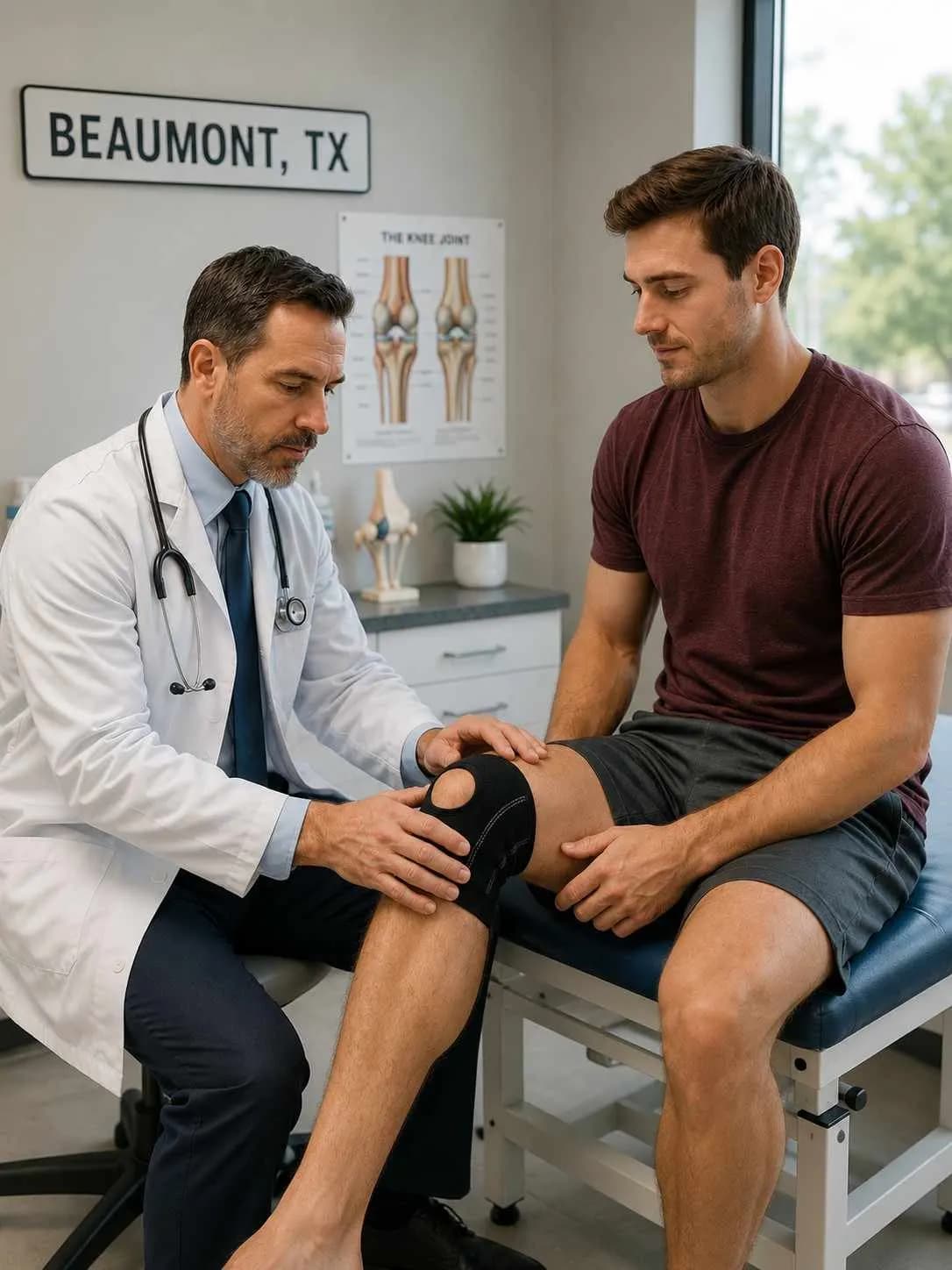
Quick answer · Key facts
- Dashboard knee injuries are a well-recognized pattern in frontal collisions, often paired with lower back injury.
- Lower back: lumbar strain, sciatica, disc bulge or herniation, and facet joint injury are the most common findings.
- Knee: ACL, PCL, MCL, and meniscus injuries, plus patellar contusions and fractures, are common after dashboard impact.
- Diagnosis combines history, a careful exam, and selective imaging — X-ray for bone, MRI for ligaments, cartilage, and discs.
- Conservative-first care (PT, anti-inflammatories, activity modification) helps most patients; orthopedic referral is reserved for ligament tears, locked knees, and persistent symptoms.
- Medically reviewed by Deepak Sharma, DC.
Why do the lower back and knees get hurt together in a crash?
In a typical frontal collision, the seat belt restrains the chest and shoulders while the lower body is thrown forward. The knees strike the dashboard, transmitting force up the femur and across the knee joint. At the same time, the lumbar spine absorbs flexion, compression, and rotation as the pelvis is pulled against the lap belt.
The result is a recognizable pattern of paired injuries: a knee that has taken direct impact, and a lower back that has been loaded and twisted in the same fraction of a second. According to the NIH MedlinePlus, dashboard impacts are a classic mechanism for posterior cruciate ligament (PCL) injury, knee dislocations, and patellar fractures.
Two regions, one accident — treating the back without the knee, or the knee without the back, often leaves the patient stuck.
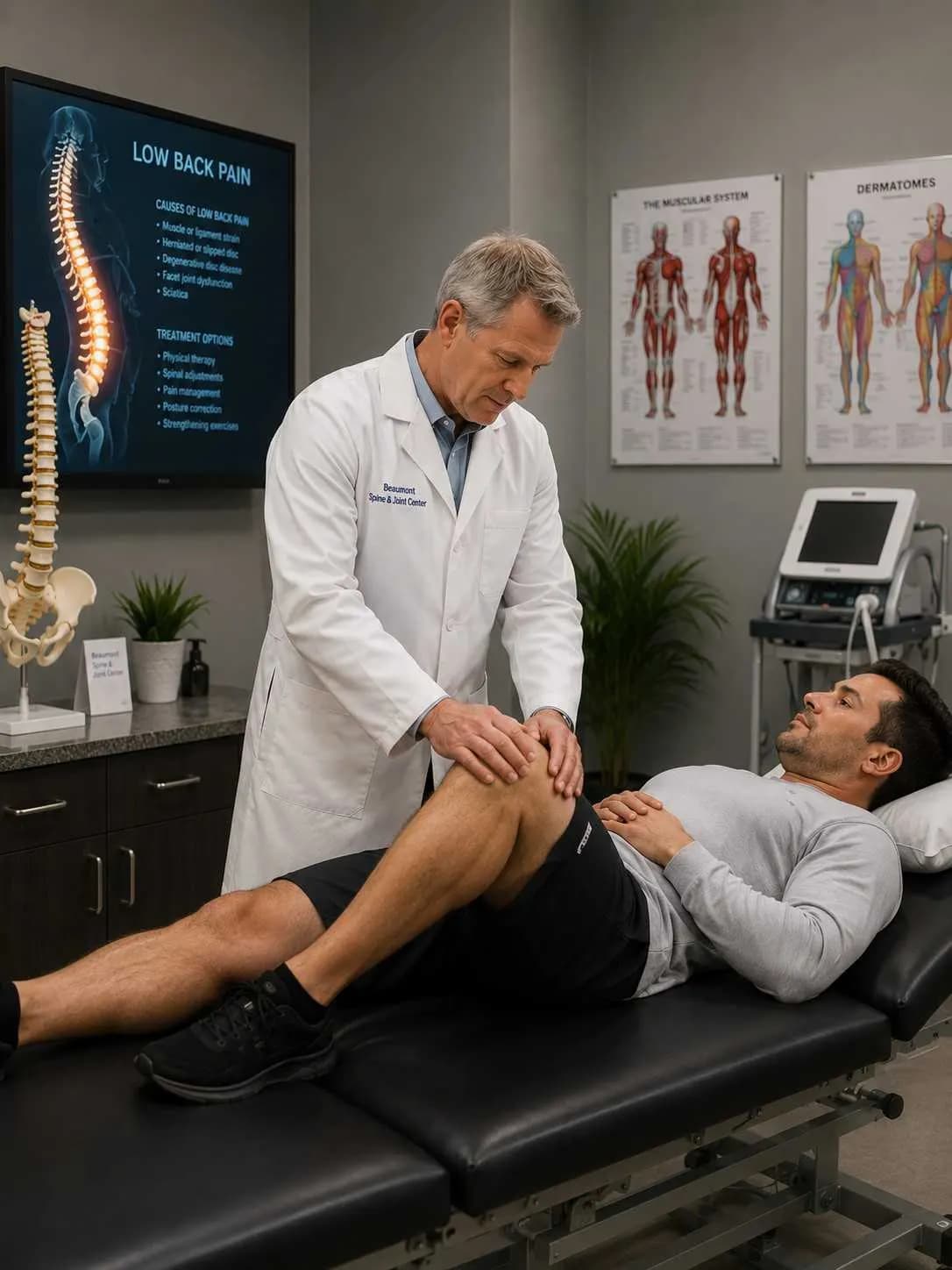
What injuries do we see most often in the lower back and knee?
Lumbar strain
Muscle and ligament strain in the lower back — the most common acute back injury after a crash.
Sciatica
Radiating pain down the buttock and leg, often from disc irritation of a nerve root.
Lumbar disc injury
Bulging or herniated discs can develop or worsen after a collision.
ACL or PCL sprain or tear
Ligament injury inside the knee from twisting or direct dashboard impact.
MCL injury
Strain or tear of the medial collateral ligament, often from lateral impact.
Meniscus tear
Cartilage injury that can cause catching, clicking, or a knee that locks.
Patellar contusion or fracture
Bruising or break of the kneecap from direct dashboard impact.
Facet joint injury
Small joints of the lumbar spine can be sprained, producing localized back pain worse with extension.
When should you seek urgent care? Red flags to know
Most back and knee injuries from a crash are not emergencies, but a small number need urgent attention. Call 911 or go to the emergency department for any of the following:
- New loss of bladder or bowel control, or saddle-area numbness (possible cauda equina syndrome)
- Rapidly worsening or severe leg weakness, or new foot drop
- An obviously deformed or dislocated knee — do not try to move it
- Inability to bear any weight on the leg, with the knee swelling rapidly
- Numbness, loss of pulse, or a cold foot below the knee
- Severe, unrelenting back pain with fever, chills, or unexplained weight loss
Outside of these red flags, ongoing pain, swelling, instability, or radiating symptoms still deserve a prompt evaluation — early treatment tends to recover better, and an early dated record protects your claim.
How do we diagnose lower back and knee injuries after an accident?
We work through both regions in a single visit so nothing is missed. Imaging is selective — we order it when the exam, the mechanism, or the symptom pattern calls for it.
- 1
History and mechanism review
Crash direction, dashboard contact, seat-belt position, and the timeline of symptoms tell us what to look for. - 2
Back exam
Range of motion, palpation, neurological testing of strength, sensation, and reflexes, and special tests (e.g., straight-leg raise) to evaluate nerve root involvement. - 3
Knee exam
Inspection for swelling and bruising; ligament tests (Lachman, anterior/posterior drawer, valgus/varus); meniscal tests; and patellar exam. - 4
X-ray when indicated
Plain films assess for fractures and gross alignment — useful early when bony injury is suspected. - 5
MRI for soft tissue
MRI is the imaging of choice for ligament, meniscus, and disc injury when symptoms persist or the exam is concerning. - 6
Specialist referral when needed
Suspected ligament tears, locked knees, or progressive neurological deficits prompt orthopedic or spine consultation.
What does treatment look like? Conservative-first, coordinated care
For most patients, recovery starts with conservative care: short-term anti-inflammatories or analgesics as appropriate, ice and elevation for the knee, activity modification (not strict bed rest), and a guided physical therapy program targeting both regions together. PT focuses on core stability, hip strength, and quad and hamstring balance — the same program supports the back and the knee.
Selected patients benefit from injections (for example, an epidural steroid injection for a lumbar radiculopathy, or an intra-articular knee injection for a stubborn effusion), and integrated chiropractic care can support back recovery for appropriate patients. Surgical referral — usually arthroscopic for the knee — is reserved for clear ligament tears, displaced meniscal tears with mechanical symptoms, or back injury with progressive neurological deficit.
Back & knee treatment: cost, insurance & attorney liens in Beaumont
The cost of evaluating and treating combined back and knee injuries depends on imaging and the specific care plan, and your coverage depends on your specific plan. We coordinate directly with health insurers and personal-injury attorneys so the paperwork does not slow your recovery.
If you do not have health insurance or are waiting on a settlement, ask about our lien-friendly arrangements: you can be evaluated, imaged, and treated now, with payment deferred and resolved through your accident claim.
Why timing matters with back and knee injuries
Two clocks start the moment of a crash — one medical, one legal. Medically, an inflamed knee or an irritated nerve root that goes untreated for weeks tends to compensate in unhelpful ways — a limp aggravates the back, back pain changes the gait — and recovery gets longer.
For your claim, a documented gap between the accident and your first visit can be used by an insurer to question whether the crash caused your injuries at all. An early, dated record protects both your recovery and your case.
Why choose Car Accident Cares for back and knee treatment
Two injuries from one accident deserve one connected plan. From the first exam to imaging and follow-up, we treat the lower back and knee together.
One plan for both regions
Selective, evidence-based imaging
Same-week evaluation
Clear orthopedic referral pathway
Lien-friendly billing
Documentation that holds up
A limp from a hurt knee will always find your back. Treating both at once is how recovery actually finishes.
Hear From Our Satisfied Clients
“My knee swelled up the day after the wreck and then my back started — they figured out it was both connected and treated me as one plan. I'm walking normal again and the limp's finally gone.”

“I'd been to two places that only looked at one thing. Here they checked my back and knee in one visit, ordered the right MRI, and got me into PT that fixed both.”

Services we use to treat this injury
Chiropractor Care in Beaumont
Spinal alignment, soft-tissue manipulation, and adjustment therapies to relieve back and neck pain after a collision.
Learn moreMD Consultation in Beaumont
Initial medical evaluation by a licensed primary-care MD to document injuries and coordinate downstream care.
Learn moreBest Affordable Beaumont MRI Diagnostic Imaging Service
High-field MRI for soft-tissue, disc, and ligament injuries — same-week appointments and transparent pricing.
Learn morePain Management Consultants in Beaumont
Non-surgical interventional pain specialists — trigger-point, epidural, facet joint, and medication management.
Learn moreOther injuries patients often have together
Whiplash & Neck Pain Treatment
The #1 injury seen after rear-end collisions — even at low speeds.
See protocolHerniated Disc Doctor
Sciatica, radiating pain, and weakness from disc injuries.
See protocolShoulder Injuries
Rotator cuff, labral tears, and seatbelt-related shoulder trauma.
See protocolChest Pain
Costochondritis, sternum injury, and seatbelt syndrome evaluation.
See protocolFrequently Asked Questions About Lower Back & Knee Pain Treatment
Don't see your question? Call us at (409) 834-4100 — we answer 24/7.
Why does my lower back and my knee both hurt after the same crash?
In frontal and angled collisions, the knees often strike the dashboard while the lumbar spine is loaded and twisted by the seat belt. The American Academy of Orthopaedic Surgeons recognizes dashboard impacts as a classic mechanism for knee injury, and the same crash that bruises the kneecap can strain or herniate a lumbar disc.Should I get an MRI for my back and knee pain?
Not always at the first visit. For most patients without red flags, a clinical exam comes first. MRI is the imaging of choice when ligament, meniscal, or disc injury is suspected or when symptoms persist despite initial care.Can a car accident cause a meniscus or ACL tear?
Yes. Twisting forces and dashboard impact can injure the ACL, PCL, MCL, or meniscus. A torn ACL often produces a sense of the knee giving way; a torn meniscus can cause catching, clicking, or a knee that locks. A clinical exam and MRI confirm the diagnosis.Is sciatica from a car accident different from regular sciatica?
The symptoms are similar — radiating pain, numbness, or tingling down the leg from an irritated nerve root — but the cause matters. After a crash, sciatica often points to a new or worsened disc injury, which deserves prompt evaluation.Do I need to see an orthopedic surgeon for knee pain after my accident?
Not always. Many knee injuries — contusions, sprains, and small meniscal tears — recover with conservative care. Orthopedic referral is appropriate for suspected ligament tears, knee locking, persistent instability, or symptoms that do not improve with PT and medical management.What kind of physical therapy helps the back and knee together?
A good program treats both regions in one plan: core stability, hip strength, balanced quadriceps and hamstring training, and gait retraining. Strengthening the chain that supports the knee also stabilizes the lower back.How long will recovery take?
Recovery varies by injury. Simple lumbar strain and a patellar contusion often improve over weeks; disc injuries and ligament sprains may take several months. Surgical injuries — for example a clean ACL tear — have their own recovery timelines and rehabilitation.When is back or knee pain an emergency?
Loss of bladder or bowel control, saddle-area numbness, rapidly progressing leg weakness, an obviously deformed knee, inability to bear weight with rapid swelling, or a cold or pulseless foot all require emergency care. Call 911 or go to the nearest emergency department.Will my insurance or an attorney lien cover treatment?
Coverage depends on your specific plan. We coordinate with health insurers and personal-injury attorneys, and we offer lien-friendly arrangements so you can be evaluated and treated now and resolve payment through your settlement.Why should I be seen soon after the crash even if it doesn't feel that bad?
Knee swelling and disc inflammation often peak days after the impact, and compensating for one injury (like limping) can entrench another. Early evaluation lets us intervene before symptoms entrench, and a dated record clearly links your injuries to the collision.
Deepak Sharma, DC is a licensed Doctor of Chiropractic and the owner of Car Accident Cares in Beaumont, TX. He reviews the clinical content published across the site and works with a multidisciplinary network of MDs, chiropractors, imaging centers, and pain-management specialists focused on accurate diagnosis, evidence-based treatment, and complete recovery for motor-vehicle-accident victims across Beaumont and Houston.
Explore Blog
What to Expect from Your Whiplash Recovery Timeline Texas After a Car Accident
Most whiplash patients recover within 6 to 12 weeks with appropriate care — but that window is not guaranteed, and for Beaumont drivers dealing with delayed sy…
Can a Car Accident Aggravate a Pre-Existing Condition in Texas?
If you have been involved in a motor vehicle collision in Southeast Texas, you likely have countless questions running through your mind. Assessing vehicle dam…
Understanding Different Types of Car Accident Impacts and Injuries
Driving through busy Beaumont TX—especially near intersections on Dowlen Road, along Interstate 10, or through the heavy traffic on College Street—means dealin…
Find Auto Injury Specialist Near You
Same-week appointments. Lien-friendly billing. Over 100 clinic locations across Beaumont and Houston.